
 Dr. Dan Siegel uses his hand to show us how the brain works in this short, descriptive video. The prefrontal cortex works to integrate the brain stem (body), limbic system (emotions) and the cortex (thinking system). When you get angry or upset, this integration can break down and the prefrontal cortex no longer connects all three parts of the brain. This is what we call flipping your lid! When your lid is flipped, you become either emotionally (and maybe physically) chaotic or rigid. Does this sound like you? It should! We all flip our lids from time to time! Watch the video HERE to get the full picture!
0 Comments
 Partners For A Drug Free America have some excellent articles for parents wanting to learn about teens and drug prevention or rehabilitation. This is a great article about how to talk to your teens about drugs. Click HERE to read the article.
I would only add a couple of things: 1. Although I do agree that parents have a way bigger influence on teens than they may realize (precisely because of the picture above--teens always act like they aren't listening, but they are!), I am afraid that peers have an even greater influence. So, get to know your friends kids. It's important. 2. The article did not talk about a big issue that I see with teens today and that is that some of their parents are using drugs. Most marijuana and alcohol but sometimes pills. Parents often think their kids don't know, but they do. Just like they are really listening (secretly), they are also really watching. They can tell when their parents are buzzed or high. So if you are using and worried about your kids using, think twice about what you say and do. It's important.  Esther Perel is an expert in relationships and shares some of her wisdom here in this video on How to Fight Better: Kitchen-Sinking. In this video, Esther tells us to keep the big picture of our relationship in mind while fighting. In other words, remember that you love and like the person you are fighting with. Here are 4 steps she outlines to improve fighting:
The video is entertaining as well as educational! If you liked it, Ms. Perel is an author and public speaker. She has many YouTube videos and an excellent TED Talk. You can go to her webpage for to access her work! "While intellectually we may know that it is our responsibility to manage our feelings, our intellect doesn't always align itself with our emotions. We may be frail, frightened, scared, lonely, angry, or clingy. We may be all of those things at once."
Do you feel like that? Here's a good article that describes some of the challenges of being a child raised by a caregiver with addiction: 10 Things to Know About Children of Alcoholics  I just had my first Reiki sesson and I have to tell you, it was like relaxing in a warm lake on a hot summer day. I'm no expert on this, obviously, but I have learned that Reiki is an energy treatment based on the belief that there is a life force flowing through our bodies. Promoting movement of this energy is said to bring relaxation and stress reduction. Relaxation and stress reduction? Count me in! I went to see a wonderful woman named Lorna who owns Restful Reiki. Here are links to her website and Facebook page if you are interested. She had me lay down on massage table, fully clothed, and I rested with my eyes closed as she moved her hands to various points on my body: head, throat, knees, feet. She says practitioners can touch or not touch at the client's preference. It was warm, nice music was playing; I'm pretty sure I fell asleep a few times. It's too soon for me to tell if there is a long term result, but I did feel very relaxed all day after the treatment and I plan to go back again!  Here is a good article on how hormones effect women with ADHD. I'm a big fan of women tracking their menstrual cycles, whether or not they have ADD or ADHD, so that they can be prepared for the "high hormone days"! But for women with ADD or ADHD, it's even more critical. Dr. Quinn's book is a great resource: Understanding Girls with ADHD, Updated and Revised: How They Feel and Why They Do What They Do.
Take a look at the article by clicking HERE.  Here are two great articles about how mindfulness and meditation can be used to help kids. In Pressing Pause, you learn how parents can use mindfulness practices to help kids calm themselves and avoid problematic behaviors. In the article by UpWorthy, children were taught meditation rather than being suspended! What great ideas!
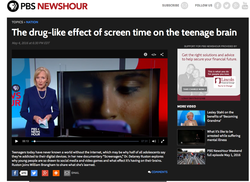 PBS has a great new story on the how screen time has a drug like effect on teenagers. In truth, screen time can effect anyone but the teen brain, because of it's unique characteristics, is more likely to be impacted.
Click HERE to go to the story.  Recently I was asked to write an article for our local online newsletter, Living Snoqualmie.
The topic was how today's technology impacts teenagers, particularly in terms of increasing stress. Here is the article! Teen pressure, stress | Social Media the New Slambook; phenomenon of FOMO  Raising kids is hard work!
Ever wish you had a nice, simple list to help you figure this whole thing out? This list from The Successful Parent is just what you need! Take note that the very first and most important "tool" for managing your kid is to have a good relationship with him or her! While you're at that website, check out some of their other great articles, as well as articles in The Successful Adult! Click here for a direct link to the article: Top Ten List for Managing Your Child's Behavior. |
 RSS Feed
